Muñoz’s film work is a refresh view of the Caribbean, mainly
Haiti and Puerto Rico, compared to what we typically see in the media. With her
way of filming – at least from what I saw in the video filmed in Haiti – really
puts you into the environment that’s being filmed. I can see what was meant by “Making
the camera another character…” in the description of the exhibit. While
at the exhibit, I didn’t understand how the mirror pieces fit with most of the
other works but having read the title of the exhibit again and having a better
understanding of the videos I now see how they correlate. I understood the
videos being presented in a dimly lit room but I found it fascinating that the
mirrors pieces and film prints were also in a dimly lit setting. I would
definitely say that for me the exhibit did simulate a cinematic experience.
Sunday, October 9, 2016
Tuesday, October 4, 2016
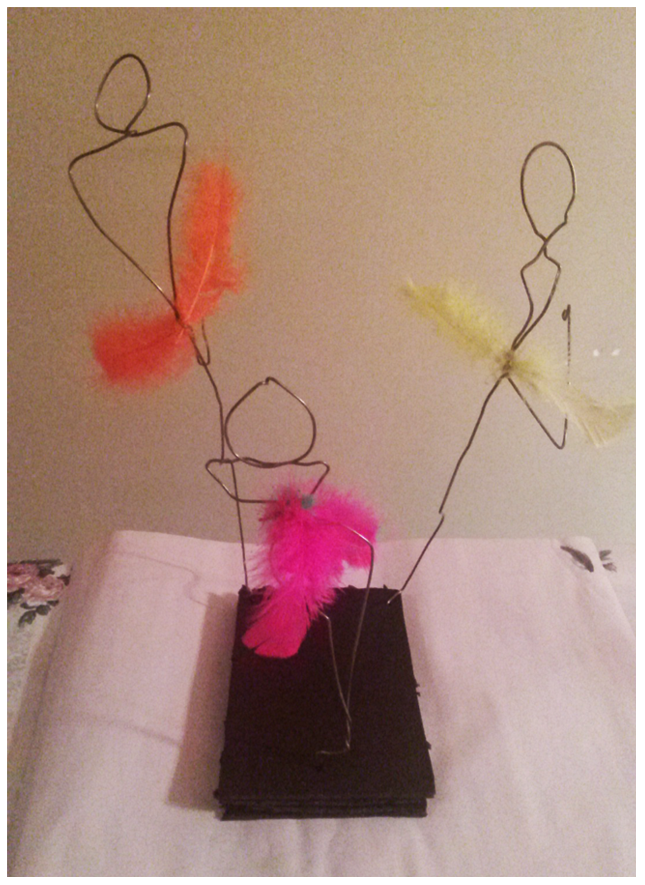
The Creative Process: In-Depth
Top:
Inspired by shadow puppets; A Haitian woman using a pilon
Bottom:
An attempt at using only wire from coat hangers to create a scene based of the Haitian Carnival
Sunday, October 2, 2016
Response to Lampert reading
Well after reading this chapter of Lampert’s writing I’ll
make such not to take in photographs at face value. Photographers have a lot
more control than I thought they did. Even though I understand that there were
Natives that liked some of Curtis’ photos, he’s methods described in this
reading just don’t sit well with me. Curtis did pretty much all he could to
capture the Natives as “vanishing people” as Lampert describes it. Also Curtis copyrighting
Throssel’s image is messed up. As a digital illustrator I’ve had to deal with
people trying to claim my artwork as their own and I’ve never thought of it
happening with other mediums that way.
Throssel on the other hand did many things to help his
community. He took photography, which some would say was negatively impacting
his community, and used it to bring awareness to and help them. His photos also
how the difference it makes when the person or people of subject are “on your
side.” Also a good way to see the difference between the two photographers is
to look at Vanishing Race by Curtis and The Rustler by Throssel side by side.
Response to Clarke reading
I can see how this chapter relates to our current
assignment. We will be creating something based off of a description very much
how like images of the rhinoceros that reached Europe were made from writings
and sketches of the animal that were received instead of those images being
made from directly observing the animal itself. At first I was surprised by how
much circulation as an “accurate representation” of the rhinoceros Durer’s
woodcut received but then realized in that day and age it’s a likely thing to
happen. For how well it’s done, I can see why the wood cut caught such
interest.
Without being familiar with the animal, at first glare the
woodcut would past as an accurate image of the rhinoceros. But when you compare
the actual the animal and the image you can clearly see the exaggerations and
the influence of Durer having designed armor. Although there is lots of talk
about Durer, he wasn’t the only one who took interest in the rhinoceros. A man
named Giovanni Giacomo Penni published an account of the animal with included a
woodcut. That woodcut having almost a completely opposite feel than Durer’s
woodcut shows how something can be shown in many different ways depending of
the presenter.
Subscribe to:
Posts (Atom)